How to Grow Your Guide Business — Profitably
.png)
A practical perspective for mountain guides
In collaboration with the American Mountain Guides Association (AMGA)
Running a guiding business is complex.
You’re managing risk, staffing, permits, logistics, weather, client expectations — and increasingly — marketing and technology.
Most guides didn’t get into this work to analyze margins or build acquisition funnels. You did it because you care about the craft.
But here’s the reality:
Busy does not automatically mean profitable.
And growth without margin is just more stress.
At Origin, we’ve worked alongside hundreds of guide services across North America. In partnership with the AMGA, we’ve seen a consistent pattern:
- Many operations are full — but financially tight.
- Many are increasing bookings — but not increasing profit.
- Many are investing in growth — without clear visibility into return.
If you want growth that actually strengthens your business, it starts with clarity.
Quick Wins: 5 Questions to Ask This Season
If you do nothing else, take 30 minutes and answer these:
- Which trip made you the most money last season — after paying guides and covering real costs?
- Which trip felt like the most work relative to what it earned?
- What percentage of your clients are repeat or referral?
- How many bookings came directly (your website/email) vs. third parties?
- If bookings increased 20% tomorrow, could your systems handle it smoothly?
If those questions are hard to answer, that’s not a failure. It’s just a signal that visibility needs to improve before growth accelerates.
📣 Watch the AMGA x Origin Webinar
Designing a Profitable Guiding Business
Before we continue, we’re excited to announce Origin and AMGA hosted a session to unpack these concepts in more detail.
We cover:
- How to calculate true trip contribution
- Identifying your highest-margin offerings
- Pricing strategies aligned with demand
- Measuring marketing performance clearly
- Building repeat demand intentionally
If you’ve never broken down profitability at the trip level — or measured growth investments clearly — this session will give you a practical starting point.
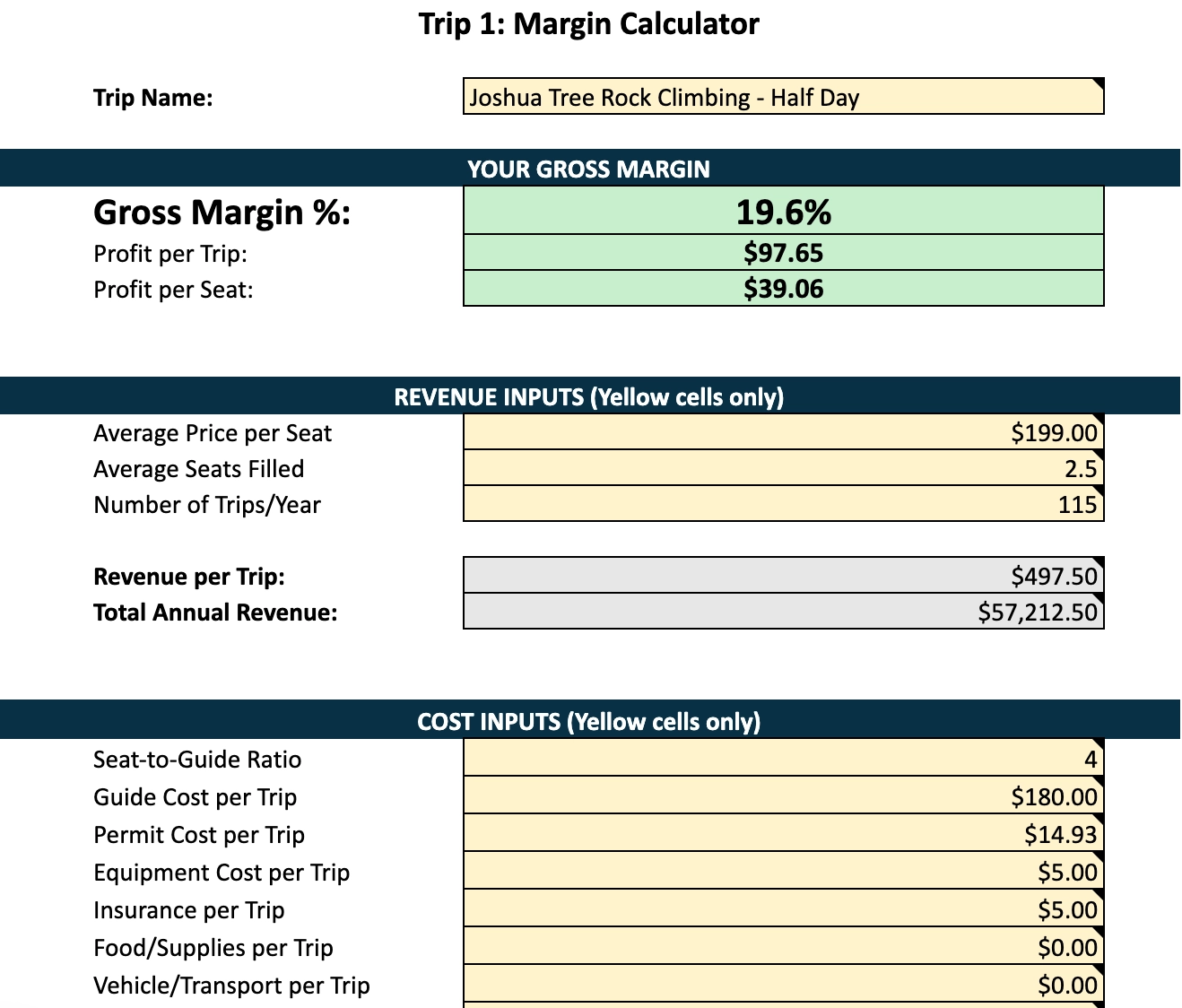
Access the margin calculator here.
Profitability Starts at the Trip Level
The most important economic unit in guiding isn’t the season.
It’s the trip.
Two courses might both bring in $6,000 in revenue — but:
- One requires two senior guides, travel days, and extensive prep.
- The other runs locally with lower overhead and strong repeat demand.
Revenue is not the full story. Contribution margin is.
When you evaluate trips individually, you start to see:
- Which offerings truly drive profit
- Which consume disproportionate energy
- Which build long-term client value
- Which simply fill calendar space
Profitable growth often comes from doubling down on the right experiences, not adding more.
Pricing Shapes Demand — It Doesn’t Just Capture It
Many guide services set pricing based on:
- What competitors charge
- What they charged last year
- What “feels fair”
But pricing is a strategic tool.
It influences:
- What clients book
- How guides are allocated
- How hard your calendar gets pushed
- Whether you attract premium or price-sensitive demand
Small pricing adjustments — especially on high-demand courses — can materially improve margin without increasing workload.
Growth isn’t always about selling more.
Often, it’s about structuring and pricing what you already offer more intentionally.
Operational Friction Quietly Eats Profit
Guiding has built-in complexity:
- Weather changes
- Permit caps
- Ratio requirements
- Travel coordination
- Equipment logistics
Without systems, that complexity turns into administrative drag.
You see it when:
- Scheduling becomes reactive
- Client emails multiply
- Guides spend time coordinating instead of guiding
- Last-minute adjustments create stress
Those inefficiencies rarely show up clearly in a P&L — but they erode margin.
Thoughtful systems and technology aren’t about “modernizing.” They’re about protecting guide time and preserving profitability.
Profitable Growth Is Designed — Not Accidental
The most resilient guide services we see share a few traits:
- They understand trip-level economics.
- They align pricing with demand.
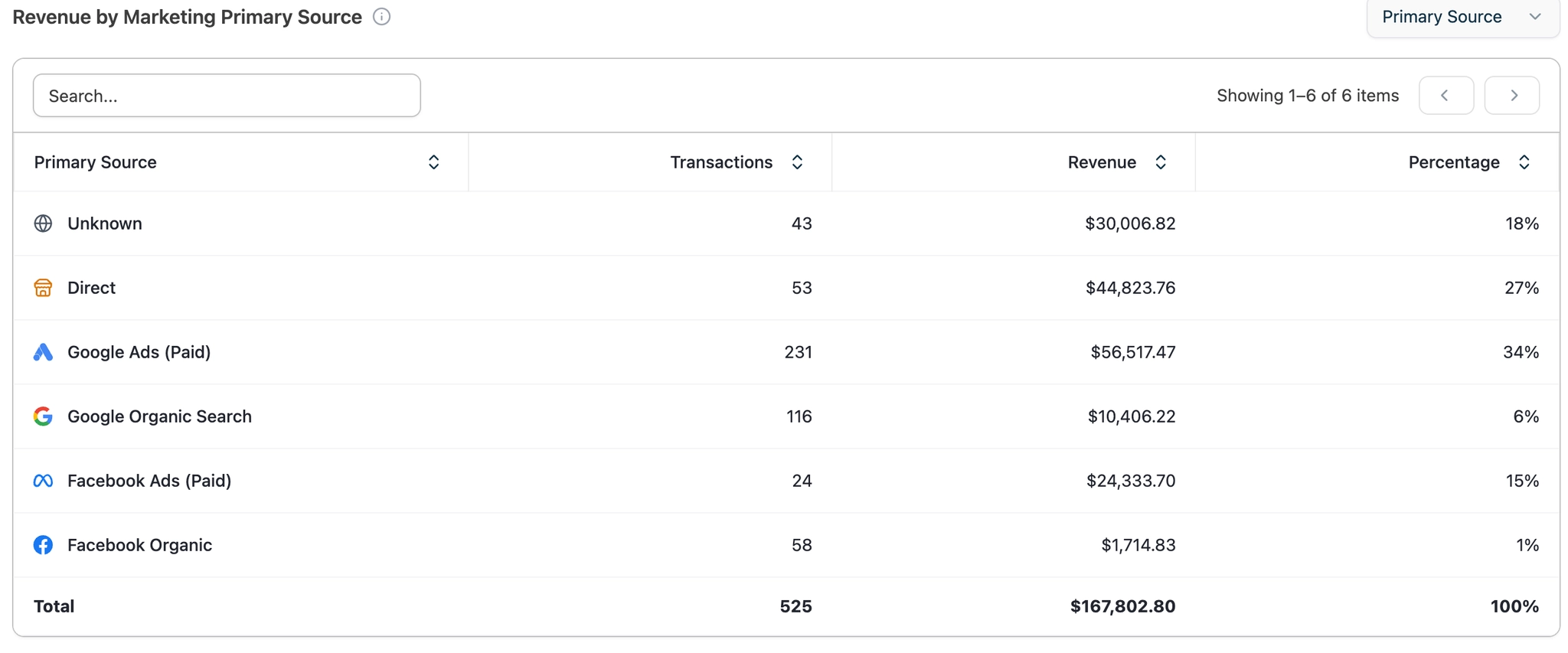
- They measure where bookings come from.
- They intentionally build repeat demand.
- They grow in ways their systems can support.
They’re not chasing every booking opportunity.
They’re shaping demand in ways that strengthen the business long term.
Closing Perspective: Professionalizing the Business of Guiding
Mountain guiding is one of the most professionalized crafts in the outdoor industry.
Training, certification, and risk management standards — shaped in large part by the AMGA — are world class.
Business operations deserve that same rigor.
Financially healthy guide services are better positioned to:
- Invest in training
- Retain top talent
- Improve safety systems
- Deliver exceptional client experiences
Profitability isn’t separate from professionalism.
It enables it.
The View: Watching Guided Clients’ Awe When They Summit